Science
10. Oktober 2016
Comet dust: A journey through time to the origins of the Solar System
Comet dust from the Rosetta mission is providing insights into the origins of our Solar System. A research project focussing on the dust, which is supported by the Austrian Science Fund FWF and being carried at the Space Research Institute (IWF) of the Austrian Academy of Sciences, has direct access to data from a high resolution atomic force microscope on board the Rosetta orbiter.
The European Space Agency’s (ESA) Rosetta mission to comet 67P/Churyumov–Gerasimenko („Tchouri“) has caused quite a stir. A project funded by the Austrian Science Fund FWF is now working on the analysis of this dust. The project leader, British scientist Mark Bentley, Principal Investigator of the MIDAS instrument on board the Rosetta, has just published the initial findings of the research in the journal Nature.
A scientific treasure chest
MIDAS, the Micro-Imaging Dust Analysis System, is a special microscope on board the Rosetta orbiter, designed, built and operated by a consortium led by IWF Graz. The instrument collects dust from the comet’s surroundings and analyses it. Mark Bentley firmly believes that the analysis of the comet dust will prove to be a scientific treasure chest: „Comets are among the earliest bodies of our Solar System. They have survived its billions of years of evolution almost unchanged, and they can provide information about the origin of the Sun and planets.“ And this is precisely what is being investigated using the data collected by MIDAS.
Cutting-edge technology
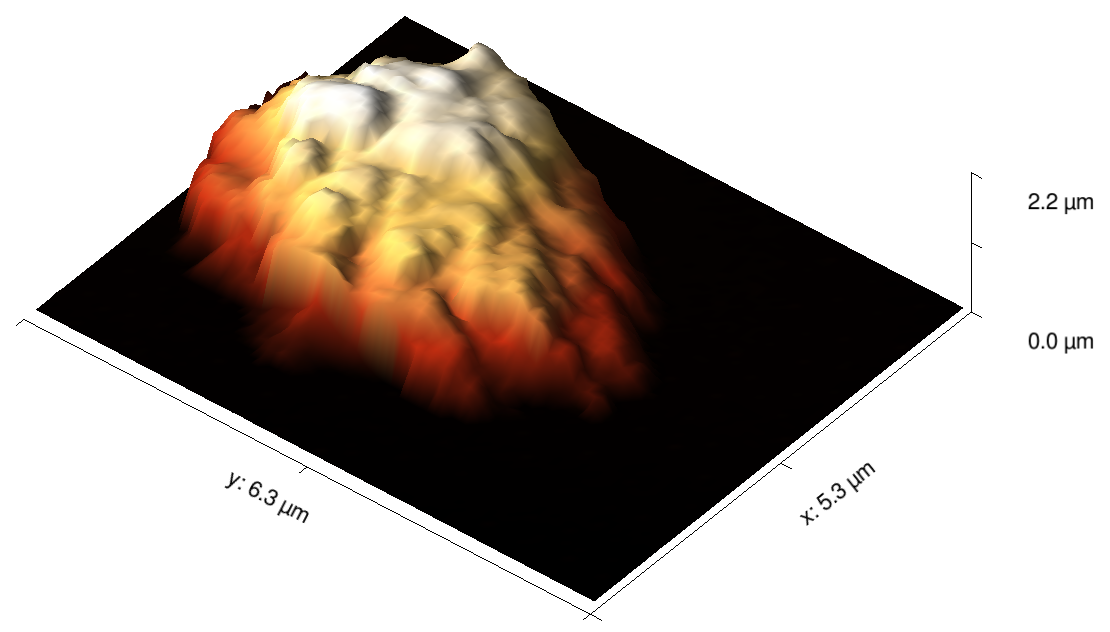
MIDAS is a specially constructed atomic force microscope that enables the analysis of dust particles at a resolution of just a few nanometres. To attain this high resolution, an extremely fine needle scans the surface of an object and the deflection of the tip by the surface structure is measured. „MIDAS allows us to create three-dimensional images of the grains of comet dust. This is crucially important for our project,“ says Mark Bentley, explaining another aspect of the measuring method.
Multifaceted dust
Like the dust he is analysing, the aims of Bentley’s research are multifaceted. He wants to determine the shape and size of different comet dust particles, analyse their surface structures, and identify the sub-grains, from which the particles are formed. As Bentley explains, thanks to the use of an additional operating mode provided by MIDAS, he will be able to extend the range of his tests even further: „We can also use MIDAS to measure magnetism. This will enable us to measure the magnetic material in the comet dust, which will tell us a lot about possible magnetic fields in the early Solar System.“
Slow science
The Rosetta mission offers a particularly crucial advantage for Bentley’s research: relative to the comet, the probe moves at a snail’s pace. This means that the dust can be collected gently and without being damaged. Bentley explains: „Earlier missions flew by various comets at a very high speed. This resulted in the particles being damaged during collection, so they were no longer in their original state. This is not the case with Rosetta.“ The dust is collected from the comet coma, the mixture of dust and gas that surrounds the comet. The careful collection method combined with the very high resolution offered by MIDAS also enables tests to be carried out on the size distribution of dust particles in the coma, on fragmentation mechanisms, and on temporal and seasonal changes in the dust particles.
Special powers
Thanks to the successful „couple’s dance“ between 67P and the Rosetta probe, which has been under way for some time now, it has already been possible to collect sufficient dust to carry out highly informative qualitative and quantitative analyses. MIDAS has already elicited considerable volumes of data from the dust. Bentley also had another scientific ace up his sleeve: because he was responsible for operating MIDAS, he not only had direct access to the very latest data from space, he could also have targeted measurements of the dust particles carried out, which furthered his research. As a result, this FWF project will make an important contribution to the understanding of our Solar System.
Personal details
Mark S. Bentley carries out research at the Space Research Institute of the Austrian Academy of Sciences in Graz. The analysis of comets and other small celestial bodies has been a significant aspect of his work in both academic and industrial research to date. He also studies space weather. He has been Principal Investigator of MIDAS on board the orbiter of the ESA Rosetta mission since 2013.
Related publications
„Aggregate dust particles at comet 67P/Churyumov–Gerasimenko„, Bentley, M. S., Schmied, R., Mannel, T., Torkar, K., Jeszenszky, H., Romstedt, J., Levasseur-Regourd, A. C., Weber, I., Jessberger, E. K., Ehrenfreund, P., Koeberl, C., and Havnes, O., Nature 537, 73 – 75 (01 September 2016). doi:10.1038/nature19091
http://www.nature.com/nature/journal/v537/n7618/full/nature19091.html
„MIDAS: Lessons learned from the first spaceborne atomic force microscope„, Bentley, M. S., Arends, H., Butler, B., Gavira, J., Jeszenszky, H., Mannel, T., Romstedt, J., Schmied, R., Torkar, K., Acta Astronautica 125, 11 – 25 (August – September 2016)
http://www.sciencedirect.com/science/article/pii/S0094576516000229
„Physical properties of dust particles in cometary comae: from clues to evidence with the Rosetta mission“, Levasseur-Regourd, A. C., Rotundi, A., Bentley, M. S. and 8 coauthors, European Planetary Science Congress 2015, held 27 September – 2 October 2015 in Nantes, France http://meetingorganizer.copernicus.org/EPSC2015/EPSC2015-932.pdf
„The Micro Imaging and Dust Analysis System – New Possibilities for Space Sciences„, Schmied, R., Torkar, K., Jeszenszky, H. and 3 coauthors, European Planetary Science Congress 2015, held 27 September – 2 October 2015 in Nantes, France
http://meetingorganizer.copernicus.org/EPSC2015/EPSC2015-865.pdf
„The nature of (sub-)micrometre cometary dust particles detected with MIDAS„, Mannel, T., Bentley, M. S., Torkar, K. and 3 coauthors, European Planetary Science Congress 2015, held 27 September – 2 October 2015 in Nantes, France
http://meetingorganizer.copernicus.org/EPSC2015/EPSC2015-863.pdf
„Cometary dust at the nanometre scale – the MIDAS view after perihelion“, Bentley, M. S., Torkar, K., Jeszenszky, H. and 3 coauthors, European Planetary Science Congress 2015, held 27 September – 2 October 2015 in Nantes, France
http://meetingorganizer.copernicus.org/EPSC2015/EPSC2015-441.pdf
„Cometary dust at the smallest scale – latest results of the MIDAS Atomic Force Microscope onboard Rosetta“, Bentley, M., Torkar, K., Jeszenszky, H. and 3 coauthors, EGU General Assembly 2015, held 12 – 17 April 2015 in Vienna, Austria., id.12477
http://meetingorganizer.copernicus.org/EGU2015/EGU2015-12477.pdf
Related video
https://www.youtube.com/watch?v=v3Dli-b2uTM
Image and text will be available as of Monday 10 October 2016, from 10.00 am CEST at: http://scilog.fwf.ac.at/en/
Scientific Contact:
Dr. Mark S. Bentley
Austrian Academy of Sciences
Space Research Institute
Schmiedlstraße 6
8042 Graz, Austria
T +43 / 316 / 4120 – 657
E mark.bentley@oeaw.ac.at
W http://www.iwf.oeaw.ac.at/en/
Austrian Science Fund FWF:
Marc Seumenicht
Haus der Forschung
Sensengasse 1
1090 Vienna, Austria
T +43 / 1 / 505 67 40 – 8111
E marc.seumenicht@fwf.ac.at
W http://www.fwf.ac.at/en/
Copy Editing & Distribution:
PR&D – Public Relations for
Research & Education
Mariannengasse 8
1090 Vienna, Austria
T +43 / 1 / 505 70 44
E contact@prd.at
W http://www.prd.at/en/
Vienna, 10 October 2016